

Breaking Barriers: The Journey of a Woman in Politics
Women in Indian politics are slowly breaking barriers and overcoming challenges that have traditionally favored men. One such woman, a well-known political leader Pallavi Satpute Jawale who is a Shiv Sena (UBT) Corporator from PMC (Saharsangatika, Shivsena (UBT) Saharpramuhk, member of DPDC, Member of Pune Zilla Niyojan Samittee, PMC sahar sudharna committee), shared her story about the struggles and victories she has experienced as a woman in politics with VUCCD
Purab Ganguli
Women in politics often face challenges that men don’t. “When I first started in politics, after working in social services, I realized that women have to prove themselves much more than men,” she said. “Some male colleagues don’t like to see women in power. They find it hard to accept that a woman can hold a higher position.”
She explained that men often get leadership roles easily, while women have to work much harder. Society praises men for being assertive, but when a woman speaks up, she’s often criticized for not being gentle enough.
Even with the 50% reservation for women in local governing bodies , gender bias still exists. In her area, many people prefer a woman leader because they believe she can understand their problems better than a man. However, women still face resistance in political spaces.
“When I was elected, I was told I needed more experience before I could join key committees like the standing committee or the city development committee. Men, on the other hand, were given these roles without question. This is a common issue—women are judged more harshly and given fewer opportunities,” she shared.
Balancing politics and family life is another challenge for women. “I live in a joint family, and their support has been a huge help in my political career. But being a mother adds another layer of responsibility. Even with support, managing both family and politics can be tough,” she said.
Despite these challenges, she continues to manage both her personal and professional life with the help of her family.
There are many barriers that women face in politics. “Women are often questioned about their experience and abilities, even if they’re new to politics. Men don’t face the same challenges—they are often given a pass. These barriers are deeply rooted in the system, making it harder for women to succeed. “I encourage all women to stand up for themselves and fight against these barriers. We are not just fighting for ourselves, but for future generations of women in politics.” she added.
However, the media plays a big role in shaping how people see politicians, and women often face unfair treatment compared to men. “If a woman politician is involved in any controversy, the media makes a big deal out of it and often questions her character. Men, on the other hand, don’t face the same level of criticism,” she noted.
She pointed out how harmful this can be, as women are often unfairly judged for actions that men are not. However, she also acknowledged that the media has helped bring attention to women’s issues, giving them a platform to speak up and fight for their rights.
The path for women in politics is tough. From dealing with gender bias and systemic barriers to balancing family and career, women face challenges that men often do not. But women like this leader are proving that they can overcome these difficulties and make a difference.
She encourages other women to keep fighting for their rights and believes that things can change. “There’s still a long way to go, but women are making their mark in politics, and with determination and support, we can break through these barriers,” she said.

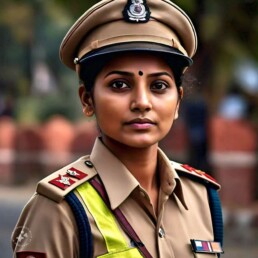
Woman in Uniform
Gender equality is one of the prerequisites for social progress. The experiences of women police officers broadly illustrate their dedication to contribute to the society and fight against crime, as well as their struggle against common prejudices and stereotypes. One such woman officer is Deepti Jadhav, who is a police constable Pune city police. She shared the story of challenges and experiences to VUCCD.
Amitava Basu ( BA Second Year Student)
Q : Hello, good morning madam. I welcome you for this conversation. Can you tell us the motivation behind joining the police force? Did you get inspired by an event or incident which brought you here?
Deepti Jadhav : Serving my country, community was my biggest motivation to join the Police force. It is not a preferred choice for many women. This requires courage and commitment towards the society and also the passion to protect the vulnerable in the society. This journey is not only restricted to physical strength but also requires mental resilience.
Q : Madam, was there any incident which reaffirmed your commitment and proved your decision to join force was the right one?
Deepati Jadhav : When we were heading towards Gadchiroli, a district in Maharashtra a bomb blast took place almost near our car, many of our police officers, constables got badly injured and some were almost on the verge of losing their lives, our team was also injured but we tried and carried the injured to the nearby hospital as soon as possible, it was one of my biggest and dreadful experience There are comes many challenges in our journey. I stood with my colleague and performed my duties. Gender is secondary when you're with dedication and for a larger goal.
Q : The gendered infrastructure and working environment is an important factor. Would you like to share your experience?
Deepti Jadhav : Yes, we get facilities that one woman police officer should get like during training, gender sensitivity training, maternity leaves, we have many facilities. We get flexible working hours and the working hours are almost the same as the men. In case of any emergency then we have to work extra hours but the time is flexible and well facilitated.We do all activities like our male counterparts.
Q : Don't you think that by giving women related cases to women officials is gender reinforcement of stereotypes?
Deepti Jadhav : No, we almost share all the cases equally.
Q : Can you shed light on your experience as a traffic officer? Is there any difference between male and female officers handling the traffic related issues.?
Deepati Jadhav : The power of the uniform stays the same irrespective of gender and, there is no scope of disrespecting or misbehaving with female officers.
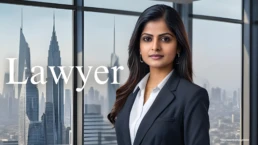
Women in Law: Megha Wagh's Story of Perseverance and Progress Amidst Gender Challenges
For many, the battle of equality is not just fought in the courtroom, but is a
constant reality.In a conversation with VUCCD, senior lawyer Megha Wagh
shared her insights, experiences, and thoughts based on the ongoing challenge
that women in the legal sector face.
Minnati Krishna (BA Second Year Student)
In a profession that prides itself on upholding justice, the scales often tip
unfairly towards women. Despite comprising nearly half of law graduates in
India, female lawyers continue to navigate a legal system where their mere
presence and competence is often questioned or met with scepticism, if not
outright bias.
For Megha Wagh, an advocate with a private practice of her own for almost
twenty years, the view on the fight against such prejudices and injustice is not
just professional but also personal. Megha Wagh started her law journey by
graduating with a law degree from the ILS (Indian Law Society) Law College in
Pune.
Her journey not only sheds light on the systematic biases present in industry but
also the resilience and determination required to rise above such biases to carve
out a successful legal career.
The legal profession in India started in the colonial era when the British started
legal education and institutions. However, from the very beginning, the field
had been overwhelmingly male-dominated. From the beginning women were
barred from practising law and legal education was inaccessible to them due to
societal norms.
Corneila Sorabji was the first woman to start practising law in the late 19th
century. She had to face tons of opposition, and despite her qualifications, was
not allowed to plead in court and had to work under male lawyers. It wasn’t
until the 20th century that women started entering this field, however, their
number remained limited and they were confined mostly to lower-status roles.
Lawyer Megha had to face certain prejudices. Due to her marriage and the
constant requirement to travel around the country, she had quite a big break in
her career.She would work part-time for law colleges when she was in Pune.
When she finally settled down in the city, she started her own private practice.
When asked about her career, she said, “The first thing they ask a woman about
is marital status and family credentials. This highlighted an employer's attitude
towards a woman. The line of questioning in job interviews usually revolves
around a woman and her marriage and family or future aspiration to get married
and start a family. No man would ever be asked about his marriage or his
personal family life as the very first question in a job interview.”
She had to face quite a lot of prejudices and assumptions that she wasn’t very
serious with her work because of the huge career gap. She also faced many
prejudices based on her age. She started her career at a very late age and was
faced with many questions by her young peers about why she was working at
her age and why she wasn't just sitting at home. She says, “Many people
assumed that I was working just to waste the time and was not that serious
about my job. This not only demotivates a woman but also creates untrue
assumptions about her choices. It also questions her competence and her
qualifications. Women have to face several taunts especially in male dominated
areas where men look down on them.”
When asked about cases and their payments, she said, “Cases don’t differ as per
gender but the payment that they receive does differ. When it comes to
payments, clients often look down on women because they feel she is not
competent enough to ask for such an amount. Men tend to get a better fee and
often are not questioned about their rates. When it comes to cases, clients tend
to avoid taking big cases, like criminal cases, to her but would often take family
related cases as they feel that women are more sympathetic and understanding.
Female lawyers tend to get women-centric cases to a large extent. She had a
different view in this regard and does not support gender reinforcement.
“Women tend to go to female lawyers with their cases because they believe that
female lawyers have the same level of empathy and understanding as them.”
Another gender bias that is prevalent is the choice a woman has to make when it
comes to her career and her family. A woman can do some outstanding work
between 9-5 and then log out to handle her family. If she is given some work
during the afterhours and she refuses to complete it, she is immediately branded
incompetent despite her best work during the assigned work hours. “Women
have to constantly fight to prove their competence and their worth. Initially, a
woman’s salary is low but as she keeps proving her worth, she is open for
promotions. However, when it comes to men, they never have to try and
“prove” their competence or worth,” she claims.
Gender discrimination in India's legal sector remains a significant challenge,
rooted in a long history of male dominance and deep-seated biases. Through the
experiences of Advocate Megha Wagh, it becomes clear that while progress has
been made, the journey toward true equality is far from over. Her story reflects
the resilience and determination required to navigate a profession that still, too
often, views women as outsiders.